
How two functionally obsolete Class B office buildings — 480 Myrtle Street and 30 Bank Street — found their highest and best use as apartments in a market where office demand had gone soft but renter demand hadn't.
New Britain's downtown was, for decades, a story told in vacancy signs. Mid-century office towers built for insurance clerks and manufacturing back-offices sat half-empty as employers shrank their footprints, first gradually and then all at once after 2020. But two blocks apart, on Myrtle Street and Bank Street, that same obsolescence became the raw material for the city's most active use of capital: housing.
Both 480 Myrtle Street and 30 Bank Street were textbook cases of a Class B office asset with no realistic office future. Both sat in a submarket where landlords were competing for a shrinking pool of tenants against newer, better-amenitized buildings. And in both cases, the winning play wasn't a rent concession or a lobby renovation — it was a change of use entirely. Amodio & Co. represented the sellers (and, in the case of 30 Bank Street, helped relocate the outgoing tenant) in transactions that moved both buildings into the hands of residential developers pursuing office-to-residential adaptive reuse.
This case study walks through each sale individually, then places them in the context of the apartment demand story unfolding across Hartford County and Central Connecticut — the demand that made the residential conversion math work in the first place.
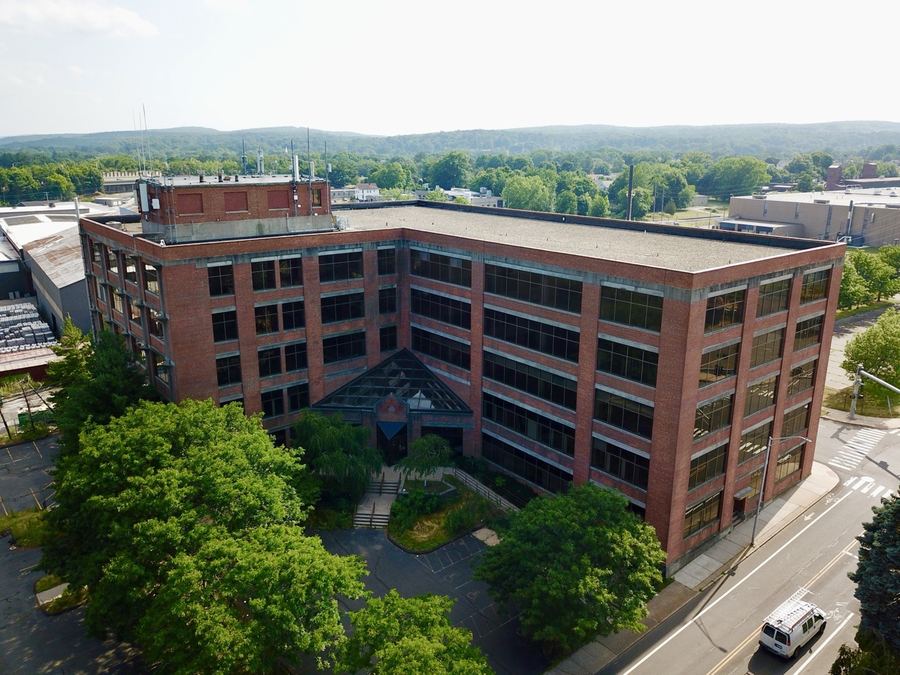
480 Myrtle Street was a 1947-built, five-story office building of roughly 125,000–139,000 square feet (figures vary between the closed transaction record and the assessor's gross building measurement), with the kind of amenity package that made sense for a 1980s insurance back-office tenant — an interior atrium, a food court, on-site property management, and 200 surface parking spaces — but that did nothing to attract a 2020s office tenant. Amodio & Co.'s Frank Amodio, CCIM and Eric Amodio, CCIM brokered the sale at $2,500,000, or roughly $20 per square foot, a basis that reflected the building's functional obsolescence as office space far more than it reflected its location, structure, or bones.
That low basis is exactly what made the deal work as a conversion. At $20/SF, a buyer could absorb the hard and soft costs of gutting and rebuilding 115 residential units — new mechanical systems, unit demising walls, upgraded life-safety and egress, a residential parking and amenity program — and still land at an all-in basis competitive with, or below, ground-up multifamily construction costs in Hartford County. The building's deep floorplates (roughly 27,800 square feet per typical floor) and structural bay spacing, often a liability for modern office tenants who want efficient, column-light space, turned into an asset for double-loaded residential corridors.
The building has since been repositioned as The Burritt, a 115-unit apartment community that leans into its industrial bones rather than hiding them — exposed structural columns, dramatic black ceilings, and floor-to-ceiling windows are marketed as the building's signature look, alongside a fitness center, business center, resident lounge, EV charging, and a pet-washing station. Studios start at roughly $1,425/month, one-bedrooms from about $1,641, and two-bedrooms from about $2,073 — rents that would have been unreachable for the building as vacant Class B office space, and that now generate cash flow from what was previously an unleasable, aging asset.
| Address | 480 Myrtle Street, New Britain, CT 06053 |
|---|---|
| Prior use / class | Class B office, built 1947, 5 stories |
| Building size | ~125,000–139,000 SF |
| Sale price | $2,500,000 (~$20/SF) |
| Sale closed | February 2022 |
| Broker | Frank Amodio, CCIM & Eric Amodio, CCIM — Amodio & Co. |
| Highest & best use | Office-to-residential adaptive reuse |
| Post-conversion | The Burritt — 115 apartment units, studio–2BR, completed 2025 |
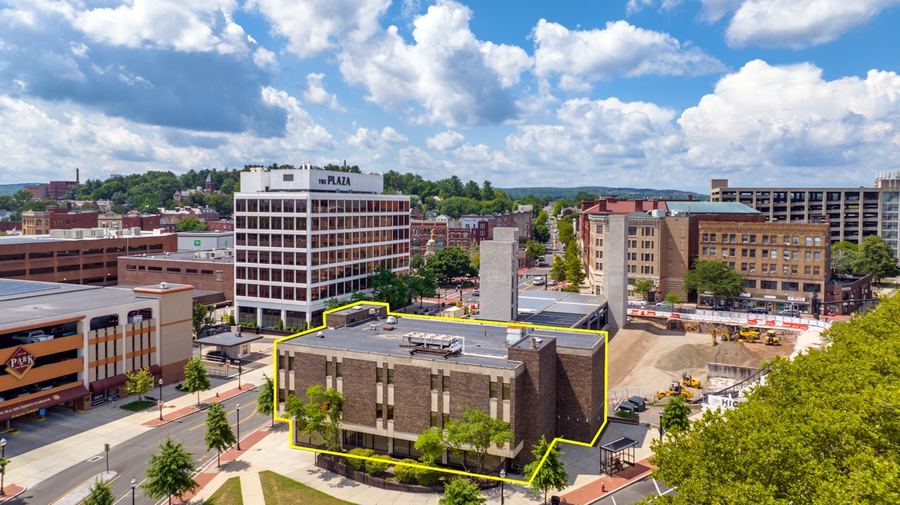
30 Bank Street presented a smaller but in some ways cleaner version of the same thesis. The four-story, 26,324-square-foot building, constructed in 1968, had served as the headquarters of the Connecticut Bar Association — a single, stable, long-term tenant whose eventual departure left the building without an obvious next office user in a downtown where Class A and trophy space was already absorbing what little office demand remained. Frank Amodio, Sr., CCIM and Eric Amodio, CCIM of Amodio & Co. represented the seller in the $900,000 sale (approximately $34/SF) and simultaneously assisted the Bar Association in relocating to new leased space, giving the seller a clean exit on both sides of the transaction.
Two site-specific factors made 30 Bank Street a stronger conversion candidate, on paper, than many downtown office buildings. First, it sits within the city's Central Business District zoning, which — unlike the industrial zoning that covers 480 Myrtle Street — more directly contemplates residential use, easing the entitlement path. Second, the property is located within a federally designated Qualified Opportunity Zone, which gave the buyer access to capital-gains deferral and exclusion benefits for investors rolling gains into the project through a Qualified Opportunity Fund — a meaningful subsidy on a deal where construction costs, not land or acquisition costs, would dominate the capital stack.
The buyer's plan, publicly branded "The Dream," called for converting the building into 32 market-rate apartments with amenity space — roughly one unit per 820 square feet of existing building area, consistent with a studio- and one-bedroom-weighted unit mix typical of small-footprint downtown conversions. At $900,000 all-in, or roughly $28,000 per planned unit for the acquisition basis alone, the deal again illustrates the core economics of this asset class: a depressed office basis is what makes the residential redevelopment budget pencil.
| Address | 30 Bank Street, New Britain, CT 06051 |
|---|---|
| Prior use / class | Class B office, built 1968, 4 stories (former CT Bar Association HQ) |
| Building size | 26,324 SF (6,581 SF/floor) |
| Sale price | $900,000 (~$34/SF) |
| Zoning / overlay | CBD zoning; Qualified Opportunity Zone |
| Broker | Frank Amodio, Sr., CCIM & Eric Amodio, CCIM — Amodio & Co. (dual representation, incl. tenant relocation) |
| Conversion plan | "The Dream" — 32 planned market-rate apartments |
Neither sale happened in a vacuum. Greater Hartford's office market has been running a persistent, structural surplus of space since well before these transactions closed. Class A vacancy across the five principal Greater Hartford submarkets has ranged from roughly 12% to 50%, and downtown Hartford itself — the region's largest and most visible office node — has approached 40% total availability, a level that leaves landlords with essentially no pricing power and tenants able to lease newer, more amenitized space for less than it costs to hold onto aging Class B and C buildings. New Britain's own office stock, older and further from the region's Class A core, felt that pressure even more acutely: buildings like 480 Myrtle Street and 30 Bank Street were never going to out-compete Hartford's newest towers for the shrinking pool of office tenants that remained.
At the same time, the residential side of the ledger told the opposite story. Connecticut's rental market has been defined for several years by tight supply and persistent demand, with statewide vacancy for new leases hovering near 2.2% — the kind of number that signals a landlord's market, not a renter's one. Statewide asking-rent growth has moderated from the sharper post-2021 spikes but has continued to run in the low-to-mid single digits on a year-over-year basis, and metro Hartford rents specifically have compounded meaningfully over the past decade, with median asking rent climbing from roughly $1,000/month in 2016 to roughly $1,700/month today — an increase of well over 50% in a market that is still, on an absolute basis, one of the more affordable metros in the Northeast. That combination — cheap, obsolete office basis on one side, and durable, rent-growing residential demand on the other — is the entire investment thesis behind both sales.
Connecticut lawmakers have also moved to make this arithmetic easier. Public Act 25-164, following an earlier 2024 bill aimed at the same problem, was built specifically to streamline the zoning and approval path for commercial-to-residential conversions across the state — a direct legislative acknowledgment that the office-to-apartment pipeline seen in New Britain is a strategy the state wants more of, not less.
New Britain sits inside Hartford County and, more specifically, inside the Capitol Planning Region — the part of Connecticut that has been posting the state's strongest population gains even as growth statewide has slowed. In the most recent year of Census Bureau estimates, the Capitol region added roughly 4,921 residents, the largest absolute gain of any planning region in Connecticut, even as the state as a whole grew by well under half a percent and several other regions lost population to domestic out-migration. That growth is landing in a housing market that, for renters, is already tight: rental vacancy for new leases statewide sits near 2.2%, well below the roughly 5%–7% level generally considered a "balanced" market, and typical time-on-market for a new listing runs under 30 days.
New Britain's own demographic profile amplifies the case for rental housing specifically, rather than for-sale product. The city is home to roughly 74,000 residents and is among the youngest and most diverse populations in Connecticut, with a median household income meaningfully below the state average — a demographic mix that skews toward renting by both preference and necessity, particularly among the 20-to-34-year-old cohort that has been the primary engine of apartment demand growth nationally. Layered on top of that is CTfastrak, the region's bus rapid transit line, which put New Britain at the western terminus of a transit corridor connecting directly to downtown Hartford. More than $32 million in state and federal transportation investment and over $10 million in municipal streetscape spending have followed the busway into downtown New Britain, and city officials credit CTfastrak directly with catalyzing the wave of transit-oriented apartment development — including 480 Myrtle Street and 30 Bank Street — that has followed. City planners project nearly 400 new apartment units in the downtown pipeline within a three-year window, and New Britain's grand list has grown for nine consecutive years, most recently by 3.8% in a single year, evidence that the residential repositioning of the office stock is showing up in the tax base, not just in press releases.
Rent growth in this specific submarket also tells a demand story. Median asking rent in the broader Hartford market has climbed to roughly $1,700/month, up more than 6% year-over-year in the most recent reporting period, with one-bedroom units around $1,310, two-bedrooms near $1,600, and three-bedrooms above $1,850 — figures that sit meaningfully below the Connecticut statewide average of roughly $2,000/month and far below high-cost Fairfield County submarkets, which is precisely the affordability gap that makes Hartford County, and New Britain in particular, attractive to both renters priced out of the state's coastal markets and to developers underwriting rent growth off a lower basis.
480 Myrtle Street and 30 Bank Street are part of a broader, active pattern of office-to-residential conversion across downtown New Britain and the wider Hartford County office market — not one-off deals. A sampling of comparable transactions and projects illustrates how consistently the market has arrived at the same conclusion about obsolete office product:
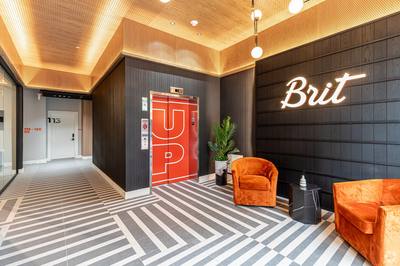
Built on the site of the former Burritt Bank Building in New Britain's Central Park district, this 107-unit, six-story mixed-use project (60 studios, 38 one-bedrooms, 9 two-bedrooms, plus 5,600 SF of ground-floor retail) opened one block from a CTfastrak station and sold to an investment firm in January 2026 — direct evidence that institutional capital is now underwriting stabilized New Britain conversion product, not just the developers doing the repositioning.
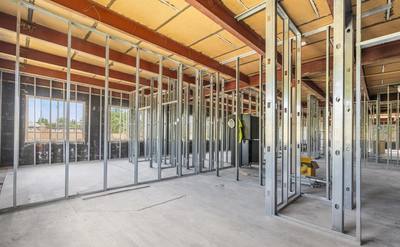
A ~23,000-SF, Class C office building trading at $700,000 in a deal that Amodio & Co. represented on both sides — another office asset with "high vacancy and deferred maintenance" repositioned for office-to-apartment conversion, underscoring that the New Britain playbook is being applied market-wide across Hartford County, not confined to one city.
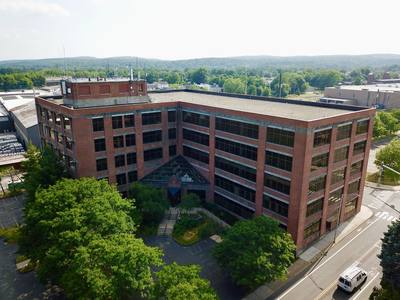
A larger-scale, harder-fought version of the same thesis: the manufacturer's former corporate headquarters spent four years working through financing delays before ultimately being redeveloped into apartments — a reminder that conversion economics are compelling in this market even when execution timelines stretch well beyond initial projections.
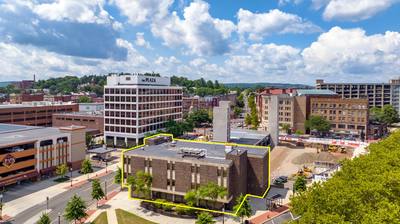
Beyond the two subject properties, downtown New Britain has seen a wave of related trades: a recently converted 20-unit apartment building resold for $4.5 million, a 3-year repositioning that turned long-vacant upper floors of one building into 24 apartments, a 56-unit residential complex (Elam Court) that traded for $4.8 million, and an active regional buyer, Krohn, that has acquired and resold multiple downtown New Britain apartment buildings converted from office and retail use since early 2025 — collectively signaling a maturing, liquid market for stabilized conversion product, not just for the raw office buildings feeding it.
The lesson from 480 Myrtle Street and 30 Bank Street isn't that every vacant office building should become apartments — zoning, floorplate depth, window-to-core ratios, and structural bay spacing all matter, and not every building converts cleanly or cheaply. But in a submarket where Class A vacancy runs as high as 40%–50% and where residential vacancy sits near 2%, the relative value of office and residential space has diverged enough that a Class B or C office owner facing rollover risk should be underwriting a conversion sale as a live alternative to re-tenanting, not a last resort. Both transactions closed at deep discounts to replacement cost as office assets — $20/SF and $34/SF, respectively — precisely because the buyers were pricing them as raw material for a different use, and both deals gave the sellers clean, timely exits from buildings that had limited remaining upside as office space.
For Central Connecticut and Hartford County specifically, the demand side of that equation shows no sign of softening: population growth is concentrated in the Capitol region, rents have compounded at a healthy clip over the past decade while remaining affordable relative to the rest of the state, vacancy for new leases sits near historic lows, and state policy is now actively subsidizing the zoning and approval process for exactly this kind of conversion. New Britain's downtown, once defined by its office vacancy, is being rewritten one building at a time — and 480 Myrtle Street and 30 Bank Street were two of the deals that started that rewrite.
Have a similar office property considering its next best use?
Let's Get Started